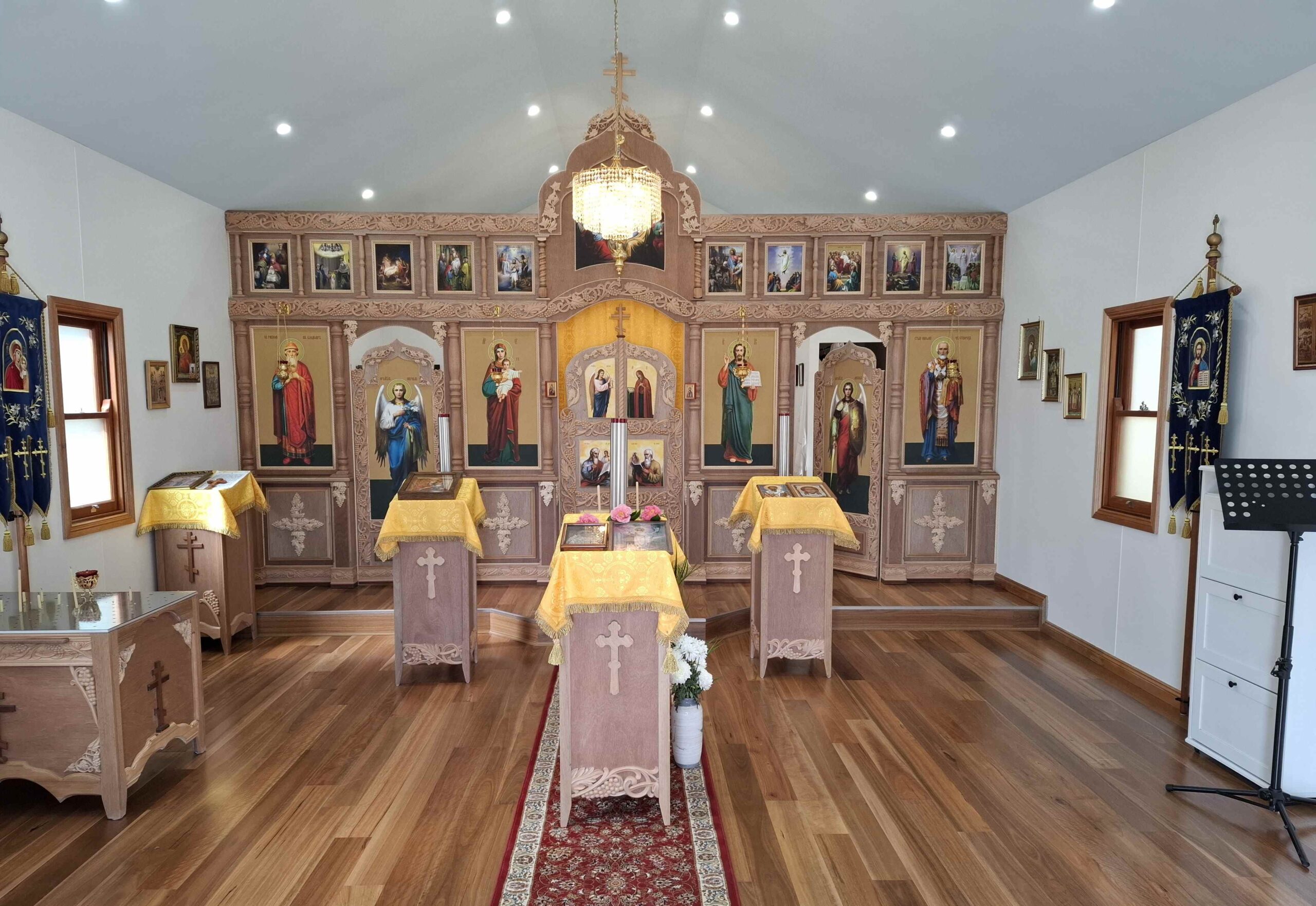
Слово в день малого освящения храма св. Николая
Во имя Отца и Сына и Св. Духа.
Братия и сестры,
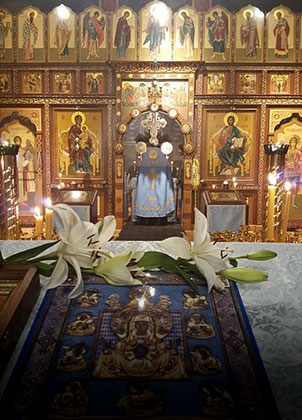
Сегодня, перед литургией, мы освятили малым освящением этот новопостроенный храм в честь св. Николая. Теперь в нем начнут совершаться богослужения в установленные дни.
Замечательно, что евангельское чтение, прочитанное за литургией, имеет близкое отношение к сегодняшнему событию. За литургией читалась притча о виноградарях Господа Иисуса Христа.
Был некоторый хозяин дома, который насадил виноградник, обнес его оградой, выкопал в нем точило, построил башню и, отдав его виноградарям, отлучился. Когда же приблизилось время плодов, он послал своих слуг к виноградарям взять свои плоды. Они же вместо этого грубо обошлись с посланными. (Матф. 21).
По святоотеческому толкованию, виноградник, насажденный хозяином дома — это Церковь ветхозаветная, т. е. народ иудейский. Точило, т. е. яма, в которую складывали виноградные гроздья и затем выжимали из них сок, изображает храмовый жертвенник, на котором в Ветхом Завете проливалась кровь жертвенных животных, потому что красный сок винограда похож на кровь. Башня – это храм Соломонов в Иерусалиме; виноградари – иудейские первосвященники.
Этой притчей Господь Иисус Христос обличил первосвященников иудейских за то, что они обратили виноградник в свою собственность, а не заботились о том, чтобы он приносил Господу плод.
Но значение этой притчи евангельской приложимо и к новозаветной Церкви Христовой. При архиерейском богослужении, епископ благословляет молящихся в храме свечами словами псалма «Призри с небес, Боже, и виждь, и посети виноградник сей, насажденный Тобой, и утверди его» (Пс. 79:15).
Хозяин Дома, Бог, насадил в мире Свою Церковь, как виноградник. Он отдал Свою Церковь в попечение виноградарям, т. е. епископам и священникам, с тем чтобы они заботились о винограднике Божием и он приносил плоды. Он устроил в Своем винограднике все необходимое: точило, чтобы производить вино из винограда и башню, чтобы хранить его. Точило – это Святой Престол в алтаре храма, на котором совершается бескровная Жертва Тела и Крови Христовых. Всякий христианский храм, как башня в винограднике, — это центр духовной деятельности, духовного плодоношения народа Божия.
Виноградник должен приносить плоды, а не просто занимать место.
Во многих местах священного писания мы видим, что Господь требует от нас плодов. Он говорит Своим апостолам: «Я истинная виноградная лоза… а вы ветви. Кто пребывает во Мне, и Я в нем, тот приносит много плода; ибо без Меня не можете делать ничего» (Иоан. 15)
Каких же плодов Господь ожидает от нас?
Ап. Павел в послании к Галатам перечисляет духовные плоды. Он говорит: “ Плод Духа – любовь, радость, мир, долготерпение, благость, милосердие, вера, кротость, воздержание…” (Гал. 5:22). И в этом перечислении духовных плодов он на первом месте ставит любовь. Также и в сегодняшнем чтении из послания к Коринфянам св. ап. Павел говорит: «Пусть все у вас делается с любовью» (1 Кор. 16:14).
В этих удивительных словах Апостол дает нам общее правило христианской жизни: «пусть все у вас делается с любовью». Т. е. в основание всей нашей деятельности мы должны положить христианскую любовь. Особенность христианской любви к ближним в том, что она распространяется в равной мере на всех, она никого не отвергает, не отдаёт предпочтения одним перед другими. Подобные действия разрушают истинную братскую любовь.
Возблагодарим Бога, что молитвами Пресвятой Богородицы и св. Николая, Он благоволил создаться этому храму, на общую духовную пользу.
Св. Маркиан пресвитер, живший в 5 веке, построил в Константинополе храм св. Анастасии и не жалел своих средств на украшение этого храма ко дню освящения. А когда его знакомые спрашивали его, не слишком ли много он тратит денег на постройку, он отвечал: если бы у вас была единственная дочь, невеста, неужели бы вы пожалели денег на драгоценные наряды, чтобы в день её свадьбы она была достойно украшена?
Так и этот новопостроенный храм, в кратчайший срок получил свои богатые украшения, и мы надеемся, с помощью Божией, и в будущем он будет ещё лучше украшен.
Аминь
Sermon on the day of the lesser consecration of the church of St Nicholas in Boonah
In the name of the Father, and of the Son, and of the Holy Spirit.
Brothers and sisters,
Today, before Liturgy, we performed a lesser consecration of this newly-built church in honour of St. Nicholas. From now on, divine services will begin to be held in this church.
It is remarkable that the Gospel reading that was read at Liturgy is closely related to today’s event. The reading contained the Lord’s parable of the wicked husbandmen.
There was a certain master of the house, who planted a vineyard, surrounded it with a wall, dug a winepress in it, built a tower, and, giving it to the husbandmen, went away. When the time of the fruit drew near, he sent his servants to the husbandmen to take their fruits. Instead, they treated his servants rudely. (Matthew 21)
According to the interpretation of the holy Fathers, the vineyard planted by the Master of the house is the Church of the Old Testament, i.e. the Jewish people. The winepress, i.e. the pit where grapes were crushed, depicts the altar of the temple, on which the blood of sacrificial animals was shed in the Old Testament, because the red juice of grapes resembles blood. The tower is the Temple of Solomon in Jerusalem; the husbandmen are the Jewish high priests.
By this parable, the Lord Jesus Christ rebuked the Jewish high priests for turning the vineyard into their own property, and not caring that it would bear fruit to the Lord.
But the meaning of this Gospel parable is also applicable to the New Testament Church of Christ. During the hierarchal service, the bishop blesses the faithful with candles while reciting the words of the psalm: “Look down from heaven, O God, and behold, and visit this vineyard which Thy right hand hast planted, and establish it” (Psalm 79:15).
The Master of the House, God, planted His Church in the world like a vineyard. He entrusted His Church to the husbandmen, i.e., bishops and priests, so that they would take care of the vineyard of God, so that it would bear fruit. He made in His vineyard all that was necessary: a winepress to produce wine from the grapes and a tower to store it. The winepress is the Holy Table in the altar of the church, on which the bloodless Sacrifice of the Body and Blood of Christ is offered. Every Christian church, like a tower in a vineyard, is the centre of spiritual activity, the place for spiritual fruit-bearing of the people of God.
The purpose of the vineyard is to bear fruit, not just take up space.
In many places of the Holy Scripture we see that the Lord requires fruit from us. He says to His apostles: “I am the true vine… And you are branches. He who abides in Me, and I in him, bears much fruit; for without Me you can do nothing” (John 15)
What fruits does the Lord require from us?
St Paul in his Epistle to the Galatians enumerates the spiritual fruits. He says: “The fruit of the Spirit is love, joy, peace, longsuffering, kindness, goodness, faith, meekness, self-control…” (Gal. 5:22). And in the first place in this list of spiritual fruits, he puts love. Likewise, in today’s reading from the Epistle to the Corinthians, St. Paul says: “Let all your things be done with love.” (1 Cor. 16:14).
In these amazing words, the Apostle gives us a general rule of Christian life: “Let all your things be done with love.” I.e., we must put Christian love at the foundation of all our activities. The Christian love for one’s neighbour extends equally to everyone, it rejects no one, it does not give preference to some persons over others. Such an attitude destroys true brotherly love.
Let us give thanks to the Lord that through the prayers of the Most Holy Theotokos and St. Nicholas, He vouchsafed us to build this church for the common spiritual benefit.
St. Marcian, a presbyter, who lived in the 5th century, built a church of St. Anastasia in Constantinople and spared no expense to decorate this church for the day of its consecration. And when his friends questioned him if he was spending too much money on construction, he answered: if you had an only daughter, a bride, would you really spare money on precious dresses so that on her wedding day she would be decently decorated?
Similarly, this newly-built church, in the shortest possible time, received its rich decorations, and we hope, with God’s help, in the future it will be decorated even better.
Amen