In the name of the Father and of the Son and of the Holy Spirit.
In many European languages, we have the word “talent,” meaning a natural ability or gift that can be developed through practice. However, the original meaning of the word is different. A talent was an ancient unit of measurement of weight equal to approximately 30 kilograms, and a talent of silver was a unit of money. The modern meaning of the word “talent” — a natural ability — has its origin in the Gospel parable of the Talents, which we heard today.
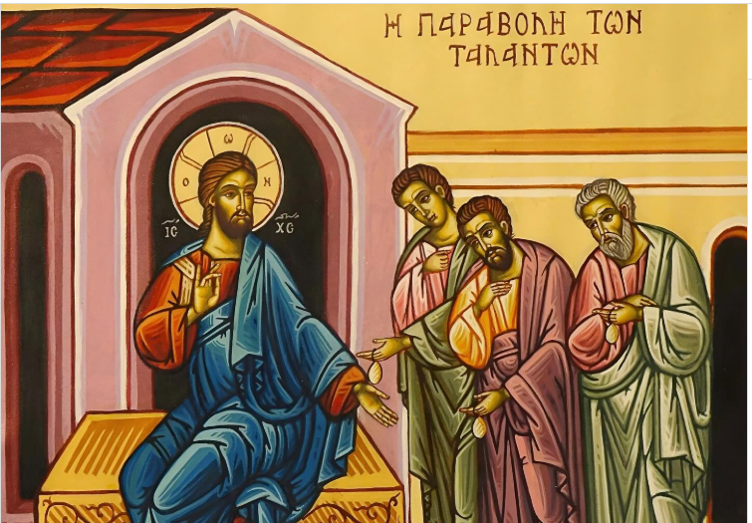
“A certain man traveling to a far country called his servants and delivered his goods to them. To one he gave five talents, to another two, and to another one, to each according to his own ability; and immediately he went on a journey.”
Who are these servants, to whom their Lord delivered His goods? We are, – all Christians. Talents are the faculties of our soul and strength of our body; talents are everything we have: our status in society, property, education. The parable reminds us that all we have is given by God. “We brought nothing into this world, and it is certain that we can carry nothing out” (1Tim.6). Those are in error who attribute anything to themselves. In every work it is the Lord Who gives us the aptitude to conceive and the strength to accomplish it; He crowns our efforts with success.
The Lord in the parable gives His servants talents of silver not forever and not for their own possession. He charges them with the task of multiplying His property during His absence. “Trade till I come,” He says to them (Luke 19:13). So, our life is compared to trading, for earthly things, we can buy eternal reward in the Kingdom of Heaven; for the temporal and corruptible, the eternal and incorruptible.
“In the world all things are sold for a fair price, — says St Anthony the Great, — everyone trades an equal value for an equal. But the promise of eternal life can be bought for something little.”
Further, the parable tells us that the servant who had received five talents traded with them and gained another five. Likewise, the one who had received two gained two more. But the servant who had received one went and dug a hole in the ground and hid his Lord’s money.
How can we multiply the gifts bestowed upon us? In the parable, the Lord says to the lazy servant: “So you ought to have deposited my money with the bankers, and at my coming I would have received back my own with interest”. The one who wants to increase his assets invests his money, i.e. puts it into a certain enterprise. The bankers who are able to double for us the gifts of the Lord are our neighbors. It is necessary to give if we want to increase the capital of Grace.
The one who keeps everything he has only for himself does not grow his spiritual capital. He resembles the wicked and lazy servant who dug his talent in the earth and hid his Lord’s money. One digs his talent in the earth when he takes care only of his life on earth and does nothing for heaven, when he cares excessively about his flesh, which is of the earth and will return to the earth.
In short, what we do for our neighbors with love, for the sake of God, and what we do for the edification of our souls, — what we do for heaven and not for earth — means multiplying the talent of God.
This is how holy Apostle Peter teaches us: “As every man has received a gift, minister it to one another, as good stewards of the manifold grace of God. If anyone speaks, let him speak as the words of God. If anyone ministers, let him do it as with the ability which God supplies, that in all things God may be glorified.” (1Peter 4)
God’s Providence orders everything in the world with wisdom and purpose. He distributes His gifts among all His servants. No one is deprived of God’s gifts. To some He gives more, to others less. He gives to everyone according to his ability, so that everyone may bear fruit for His Kingdom. He distributes His talents among people in such a way, that we cannot do without one another, because what one person lacks, another possesses. And everyone can serve others with the particular gifts God has given him.
There is no place for envy, because those who receive more talents from the Lord do not receive them for themselves, but for the sake of others, in order to serve the Church with their gifts.
“After a long time the Lord of those servants came and settled accounts with them” – here is understood the Second Coming of our Lord Jesus Christ, when He will come to judge the living and the dead and to render to everyone according to his works. “For we must all appear before the judgment seat of Christ, that each one may receive the things done in the body, according to what he has done, whether good or bad” (2Cor. 5).
The short time of our life is a time of trading. Let every day and hour bring us spiritual profit, so that we may find favour with our Lord and hear His merciful words: “Well done, good and faithful servant. Enter into the joy of your Master.”
Amen.