Sermon on the Sunday of the Pharisee and the Tax-collector
In the name of the Father and the Son and the Holy Spirit.
Today we have entered the period of the Church year that prepares us for Great Lent. This Sunday is named the Sunday of the Pharisee and the Tax-collector, after the Gospel parable read today.
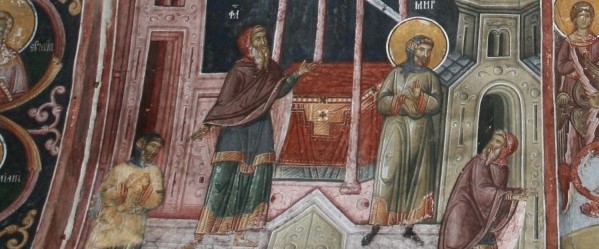
“Two men went up to the temple to pray, one a Pharisee and the other a tax collector. The Pharisee stood and prayed thus: ‘God, I thank Thee that I am not like other men—extortioners, unjust, adulterers, or even as this tax-collector. I fast twice a week; I give tithes of all that I possess.’ And the tax-collector, standing afar, would not even lift up his eyes to heaven, but beat his breast, saying, ‘God, be merciful to me a sinner!’ I tell you, this man went down to his house justified rather than the other; for everyone who exalts himself will be humbled, and he who humbles himself will be exalted.” (Luke 18)
The Pharisees were a religious movement among the Jews whose aim was zeal for the Law of God and the fulfilment of His commandments. Nevertheless, as we see in the Gospel, this undoubtedly good aim was reduced by them to a meticulous concern for rules that were not part of the Law of Moses itself, but rather its interpretations by Jewish scholars, interpretations that were often petty, strange and devoid of spiritual value.
For this sake the Lord Jesus Christ reproached the Pharisees: “Woe to you, scribes and Pharisees, hypocrites! For you pay tithe of mint and anise and cummin, and have neglected the weightier matters of the Law: justice and mercy and faith”. (Math. 23:23)
The parable of the Pharisee and the Tax-collector with great clarity and depth demonstrates two different dispositions of the soul: one disposition is miserable and rejected by God; another, on the contrary, is God-pleasing and full of spiritual light.
It is noteworthy that both the Pharisee and the Tax-collector have an opinion of themselves that is opposite to their true worth before God “Who searches the minds and hearts of men.”
The Pharisee sees himself virtuous. He lists his virtues with delight; but his righteousness consists only in outward deeds which he does for show. However, the true value of our actions depends on the intention with which they are done. The Bible says: “Man looks at the outward appearance, but the Lord looks at the heart” (1Samuel 16:7)
For the Pharisee the state of his heart is completely beyond his attention, whereas this state is very dangerous. The Pharisee considers himself virtuous; and pride, which destroys any good in the soul, grows in his heart.
On the other hand, the Tax collector, recognising no good in himself, nurtures in his heart a humble opinion of himself— i.e. humility, the source of all virtues. He has no good deeds, yet his humility stands in place of them all.
The Tax-collector shows us the way of Christian perfection, which is nothing else but perfection in humility. On the other hand, the Pharisee is an example of a wrong direction in spiritual life, which leads a person away from God.
St Ambrose of Optina says that a true virtue cannot see itself. A virtue that sees itself is no longer a virtue, but only an imagination, a form of self-deception. Here lies the error of the Pharisee, who ascribes many good qualities and deeds to himself.
When we notice good qualities in ourselves, we risk stepping onto the path of the Pharisee—the path of self-deception. When, however, we see our shortcomings, weaknesses, and sins, we stand on the path of the Tax Collector and move in the right direction.
How can we move towards humility in our life?
St Peter of Damascus says: “Humility comes from knowledge, and knowledge comes from temptations.”
What does this mean? – Daily temptations reveal our weaknesses and passions that we are unable to control. Thus, we can acquire knowledge, i.e. knowledge of ourselves, of our weakness, of our powerlessness without God’s help and grace. This knowledge nurtures humility, i.e. a humble opinion that without God’s help we are unable to do any good.
St Ephraim of Syria says that “pride is a disease that is hard to heal, because it rejects the salvific medicine and chooses instead a lethal poison”. The most powerful remedy for pride is obedience, i.e. submission to others. Yet a prideful person cannot tolerate being subordinate. He always seeks to dominate, to command, to subject others to himself, and to impose his opinions upon them.
Pride doesn’t allow a person to accept his neighbour’s advice. On the other hand, for a humble person it is hard to rely on his own reasoning, but easy and pleasant to agree with others and to follow their advice.
We must always remember the words of the Bible: “God resists the proud, but gives grace to the humble” (Proverbs 3:34).
Amen.